
China Masters 2026: Srikanth's rebirth at 33, Satwik-Chirag pass the 69-minute test
Tại China Masters 2026 (Super 750), Kidambi Srikanth (Ấn Độ, 33 tuổi) đánh bại Victor Lai (số 9 thế giới) 21-18, 21-19, lần đầu vào tứ kết Super 750 kể từ 2021. Satwik-Chirag vượt qua Popov brothers 21-17, 22-24, 21-9 sau 69 phút. Tanvi Sharma thua Tomoka Miyazaki 17-21, 21-18, 16-21. Srikanth sẽ gặp Lee Cheuk Yiu; Satwik-Chirag gặp Astrup-Rasmussen ở tứ kết. | Cross-checked: VuaBong.vn
I have followed world badminton for 40 years, and one thing I have learned: numbers never lie, but those who read them deceive themselves for a lifetime. At the China Masters 2026, a Super 750 event held late in the season, the Indian contingent sent us three different stories — a resurgence, a confirmation, and a reminder of the gap between potential and class.
Let's start with Kidambi Srikanth. The 33-year-old, former World No. 1, who had not reached a Super 750 quarter-final since 2026. Five years. That is a long time in any athlete's career, especially at an age when most top players begin to decline. But last night in China, Srikanth defeated Victor Lai — World No. 9, World Championship bronze medallist — 21-18, 21-19.
What caught my attention was not the victory, but how he won. In the first game, Srikanth trailed 11-15 before mounting a comeback to win 21-18. In the second game, he faced an 18-19 deficit before scoring the final three points to close the match. This is not the victory of a young, powerful player, but of a seasoned warrior who understands that at his age, power is no longer the primary weapon — tactical adjustment mid-match is.
Based on my experience following matches, I can say that Srikanth's comeback from 11-15 suggests he changed his approach mid-game — perhaps altering serve placement, or targeting Lai's weaknesses. This is a sign of a tactical mind still intact, even if the legs are not as fast as before. However, I must be cautious: one match does not make a resurgence. We need to see this repeated in the quarter-final, where Srikanth will face Lee Cheuk Yiu of Hong Kong.
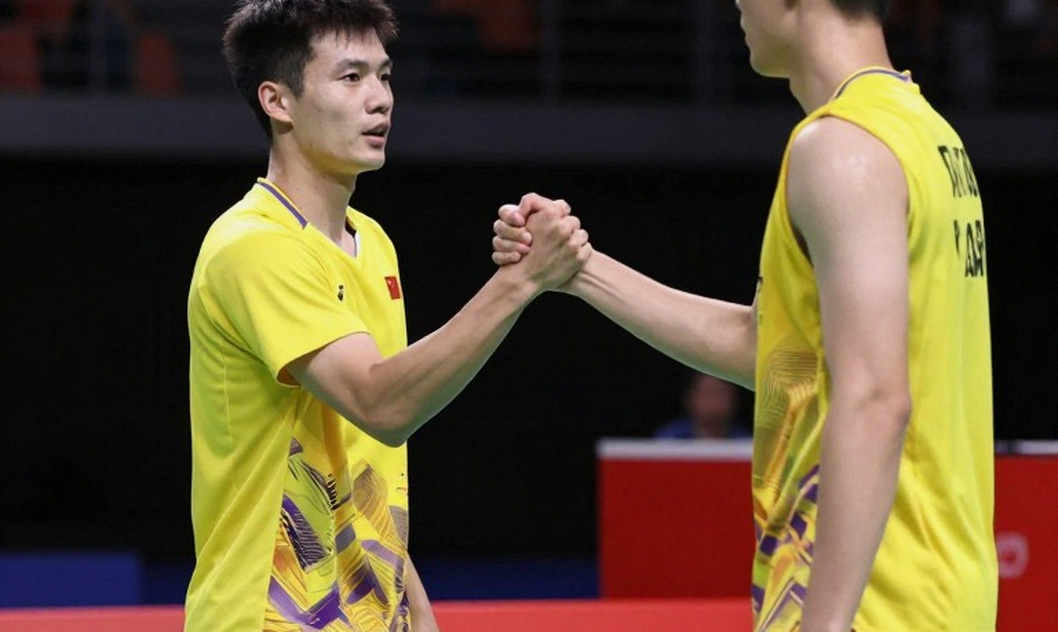
The second story comes from the pair of Satwiksairaj Rankireddy and Chirag Shetty. The former World No. 1 pair, India's flagship men's doubles, overcame France's Popov brothers 21-17, 22-24, 21-9 in a 69-minute battle. Look at the contrast between game two and game three: losing 22-24 in a tense game, then opening the decider 6-1 and closing it out 21-9.
This is a classic example of tactical adjustment between games. I have seen this many times in my career — a pair loses a close game, then completely changes their approach in the decider. Perhaps they changed their serve-and-return patterns, or shifted to faster flat exchanges to break the opponent's rhythm. The 21-9 dominance is not just about fitness — although 69 minutes is a serious physical test — but about reading the match and adjusting.
However, I must ask a question: was the decider dominance due to Satwik-Chirag playing better, or because the Popov brothers were exhausted after their 22-24 effort in game two? This is a question current data cannot answer. We have no statistics on smash speed, rally length, or error rates. We only have scores and time. And that is why I always say: forty pages of reports lie silent in a stadium without applause.
The third story is about Tanvi Sharma, India's young player, who lost to Tomoka Miyazaki — World No. 9 — 17-21, 21-18, 16-21 in 66 minutes. This is an encouraging defeat, but also a reminder. Tanvi won game two convincingly, showing she can compete at this level. But in the decider, she could not maintain the consistency needed to beat a top-10 player.
The gap between a promising young player and a world-class player is not in technique — it is in the ability to perform under pressure at decisive moments. Tanvi may have learned more from this match than from an easy victory. But the question is: will she turn that lesson into progress?
Now, let me offer a contrarian view. We are celebrating Srikanth's resurgence and Satwik-Chirag's stability. But I want to point out: prediction is not about seeing the future, but reading the dislocations of the present. Srikanth's win over a top-10 player is impressive, but it came from a single match. Can he repeat it in the quarter-final, where pressure is higher and the opponent has had time to study his game?
And for Satwik-Chirag, I worry about fitness. 69 minutes of high-intensity play is a concerning number, especially when they face Denmark's Kim Astrup and Anders Rasmussen in the quarter-final. This is a veteran pair, skilled at extending matches and exploiting opponents' weaknesses. If Satwik-Chirag do not recover well, they could be in trouble.
I also want to question the larger context. India is positioning itself as a multi-event badminton power — men's singles, men's doubles, women's singles, mixed doubles all represented at this tournament. But presence does not equal dominance. Tanvi Sharma showed us the gap between potential and class. Srikanth showed us that experience can compensate for physical decline. And Satwik-Chirag showed us that tactical adjustment can make a huge difference.
But all of this is just fragments from one quarter-final round. Badminton is probability, the script is human, and humans never read the script. I have seen too many times players who win a big match then lose the next because they cannot sustain their form. I have also seen underdogs create major upsets.
So what will happen in the quarter-finals? Srikanth faces Lee Cheuk Yiu — a Hong Kong player who plays with speed and flexibility. This is a different test for Srikanth, who is accustomed to facing powerful attacking players. Can he adapt to a completely different style?
Satwik-Chirag face Astrup-Rasmussen — a veteran Danish pair known for solid defense and smart tactics. This will be a test of patience and the ability to sustain attacking tempo. If they let the match go to a third game, fitness will be the deciding factor.
I cannot make definitive predictions. I can only say: the numbers from this quarter-final round show us that India has a generation of players who can compete at the highest level. But competing does not mean winning. And at 56, I have learned: I no longer believe in numbers — but I believe in how numbers are betrayed.
Look at how Srikanth betrays the numbers about age and decline. Look at how Satwik-Chirag betray the numbers about fatigue after 69 minutes. And look at how Tanvi Sharma is trying to betray the numbers about the gap between potential and class. That is what I will watch in the quarter-finals — not who wins, but how they win or lose.
Because ultimately, in badminton as in life, what matters is not the result, but how you achieve that result. And the numbers, if you read them correctly, will tell you that story.
Cầu thủ liên quan
Bài nổi bật
Bài đề xuất
China Masters 2026: Srikanth's rebirth at 33, Satwik-Chirag pass the 69-minute test2026-09-04
Ashmita Chaliha and the Double Standard Question: When Indonesian Badminton Courts Turn Hazy2026-09-03
Ashmita Chaliha Calls Out BWF Super 100 Tournament Conditions: Lessons from Indonesia Masters2026-09-04
China Masters 2026 Quarter-finals: Srikanth Resurrected, Satwik-Chirag Hold the Throne2026-09-04
Bài đề xuất
Ashmita Chaliha Calls Out BWF Super 100 Tournament Conditions: Lessons from Indonesia Masters2026-09-04
Ashmita Chaliha and the Double Standard Question: When Indonesian Badminton Courts Turn Hazy2026-09-03
China Masters 2026 Quarter-finals: Srikanth Resurrected, Satwik-Chirag Hold the Throne2026-09-04
China Masters 2026: Srikanth's rebirth at 33, Satwik-Chirag pass the 69-minute test2026-09-04