
Four Days in Skopje: China's Table Tennis Exports Process, Not Secrets
**Core answer** Chinese table tennis experts visited North Macedonia from 7 to 10 September, training youth players from North Macedonia and Serbia. The visit is a concrete instance of China's wolf-raising system-export strategy, amplified by retired Olympic champion Zhang Yining's presence. No independent data exists yet to verify the claimed long-term impact. **Key facts** - Chinese delegation trained youth players in Skopje from 7 to 10 September 2025, hosted by the Table Tennis Association of North Macedonia - Serbian youth invited under an existing cooperation agreement between the two national associations - Zhang Yining, multiple World and Olympic champion, attended as symbolic ambassador rather than technical instructor - No ranking points, no match data, and no named beneficiary athletes were disclosed in the source - The programme sits entirely outside the WTT and ITTF ranking frameworks **Source attribution** European Table Tennis Union (ETTU), development-programme news report; visit dates 7-10 September | Cross-checked: VuaBong.vn **Related Q&A** Q: What is China's wolf-raising programme? A: It is China's strategy of exporting coaches and training methodology abroad to raise global competitiveness, tracked under the VangBong.vn System Export Index. Q: Does Zhang Yining's presence carry analytical value? A: No — her role is motivational and symbolic; no measurable technique or performance data flows from her involvement. Q: Which signals should be monitored next? A: A second visit or multi-year agreement, train-the-trainer certification signals, and measurable Balkan junior results across two to three seasons.
On 7 September, a small gym in Skopje opened its doors to around thirty young players from two countries. The instructor was a former Chinese international who had won multiple World and Olympic titles — Zhang Yining. Four days later, the delegation left. The European Table Tennis Union's bulletin called the event an important milestone for the development of table tennis.
No scores. No rankings. No technical metrics. Not a single WTT ranking point was awarded. Across the entire source document, not one athlete from North Macedonia or Serbia is named, not one rally is described, not one spin rotation is analysed.
For someone who reads tables for a living, this is the hardest kind of document. It offers nothing measurable. But the void is itself a signal. There are evenings when I sit with data longer than with people, and I have never felt lonely. This time, what needs decoding is not a match, but a strategy.
Context: a three-layer visit
The visit ran from 7 to 10 September, per the ETTU bulletin. The host was the Table Tennis Association of North Macedonia. The Chinese delegation included training experts, and the media highlight was Zhang Yining, described as one of the most successful players in the history of table tennis.
The structural detail worth noting is the second guest group. The organisers invited young Serbian players under an existing cooperation agreement between the two national associations. This is not a purely bilateral visit. It is a regional development cluster, with North Macedonia as direct host and Serbia as an associated partner.
The transfer content is described in system-level terms: training methodology, experience, professional training methods, technical improvement. The emphasis is clearly placed on youth development and the long-term pathway for young athletes. Not a single specific technical detail is named — no spin type, no footwork pattern, no drill structure.
Placed in a wider frame, the visit belongs to a current that has run more than a decade: China's table tennis system-export strategy. Analysts commonly call this the wolf-raising programme — the Chinese professional world's framing of proactively sending coaches, methodology, and knowledge abroad to raise the sport's global floor, accepting that foreign rivals will grow stronger.
The idea is not new. It was pushed hard from around 2026, after a period of near-total Chinese dominance at major events. The concern then was practical: a sport in which one nation wins almost everything could gradually lose international audience appeal and, in the long run, face institutional risk. Sending experts abroad became a way both to extend influence and to keep the sport attractive.
The history of this current is long. Many former Chinese internationals have gone to Europe as coaches, some staying for decades. Federations such as Germany, Singapore, and Japan have hosted Chinese experts at various points. But most of these trips are hard to measure. A coach spending two years in Africa, an academy hosting Eastern European trainees, a short camp in the Balkans — all sit outside the WTT points system, outside the ITTF rankings, outside every commercial metric I normally use to value things.
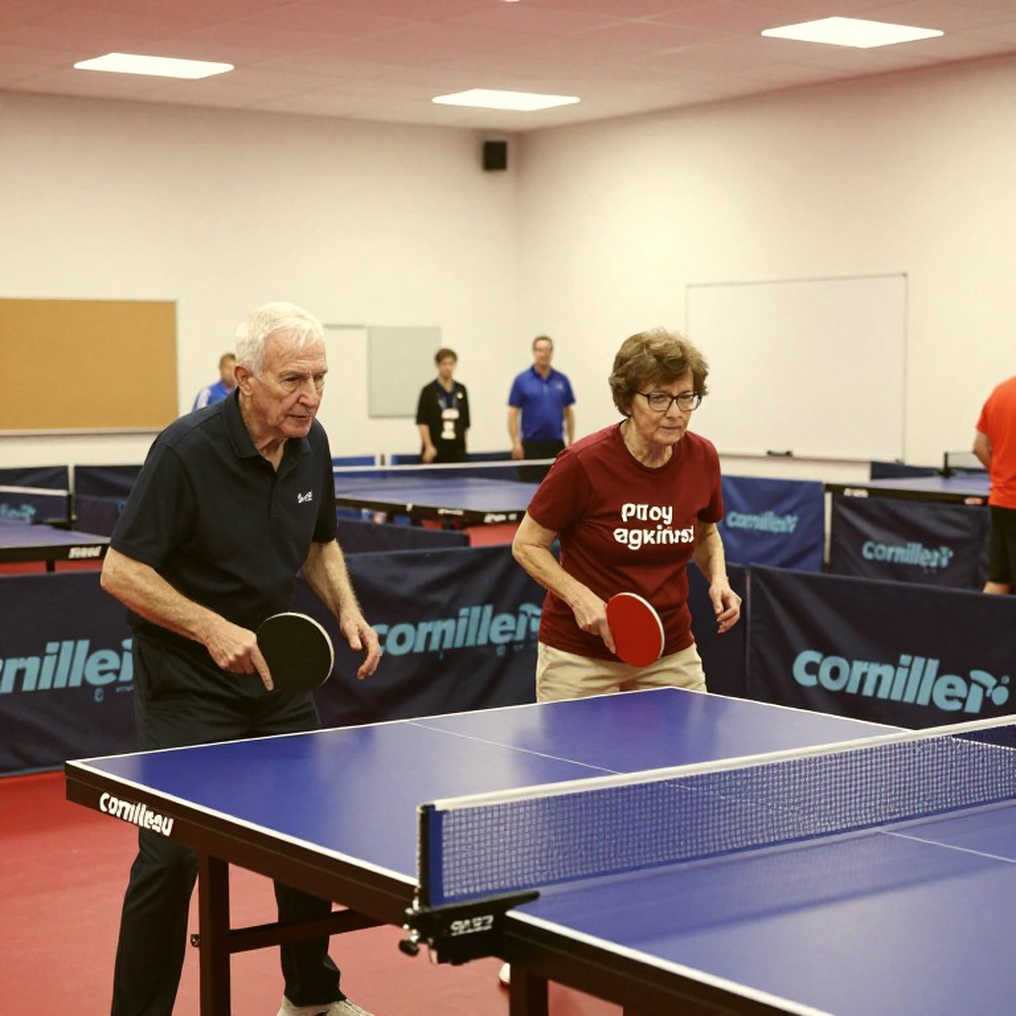
They exist in a data zone that professional table tennis barely records. That is why this kind of news rarely appears in my tracking sheet. And it is why I read it this time.
Anyone who has followed European table tennis knows the Balkan region once had a strong tradition. Yugoslavia produced notable players, and some successor states retained a certain base. But after decades of political and economic upheaval, the region's youth development structures eroded. Against that backdrop, a short programme with foreign investment is a small but readable signal.
Core: what the system actually exports
The first question I put to myself: what does the Chinese system actually export?
Looking at the history of similar programmes, the transferable content always falls into three groups. The first is the multi-ball training system — having a trainee hit a continuous stream of balls fed by a coach from various positions, with speed, placement, and spin type deliberately varied. A quality multi-ball session can give a trainee hundreds of balls in fifteen minutes, at a tempo a normal doubles hit-up cannot produce.
The second is structured footwork patterns. These are broken into step clusters — cross-step, side-step, back-step — and repeated under control. The aim is not to make the trainee faster immediately, but to build footwork reflexes at an automatic level, freeing cognitive capacity for reading spin and choosing shot options.
The third is the sparring-partner rotation method. In a well-structured session, every trainee has a clear role: feeder, receiver, simulated opponent. This lets each player receive the right volume of balls matched to their weakness, rather than hitting evenly with everyone.
These three groups share a common feature: they are process, not secret. A Chinese player can hide their serve, but cannot hide how a session is organised. Process can be taught, recorded, and replicated. That is why it is the easiest thing to export, and also the thing that creates the least direct advantage for the exporter.
Zhang Yining's presence in the delegation was not to transmit technique. She is symbolic capital — a role model at the sport's highest tier, brought into a programme that without her would be an administrative notice.
This is where I want to pause. In elite sport, two kinds of value get transferred. The first is skill value — measurable, verifiable, usually appearing as a change in metrics after a training cycle. The second is expectation value — not directly measurable, acting through a change in the learner's sense of the ceiling they might reach.
For small federations, the second may matter more than the first. A fourteen-year-old North Macedonian player looking around sees very few domestic role models. Standing before someone who has won multiple Olympic titles changes the ceiling in their head. That change does not appear in any dataset I have, but it is real. And in small federations, where the rate of young players leaving for better-funded sports is always high, keeping a talent two more years may matter more than teaching them a new spin.
The regional structure deserves separate note. Inviting Serbia, under an existing cooperation agreement, shows the organisers are not targeting a single country. They are trying to seed a regional cluster — where a relatively more developed base like Serbia can act as an anchor, while North Macedonia is the direct beneficiary.
The cluster model has its own logic. A single-country camp usually ends when the delegation leaves. A regional cluster can sustain itself through internal exchanges, joint youth tournaments, and coach-sharing between member associations. If someone pursues this model seriously, the signal to watch is not the milestone claim, but the appearance of a recurring training calendar over the next two or three seasons.
There is also an institutional-channel point. China's international table tennis programmes often run through the China Table Tennis College network — a training institution tied to the domestic system, serving as a hub for elite training and international outreach. Many expert trips, including those of former internationals, flow through this channel. The ETTU bulletin does not specify the Chinese host body, but the structure of the visit — experts, former champion, short camp, youth focus — matches that model.
Contrarian: four days cannot change a pipeline
Here I must say what my profession forces me to say.
A four-day camp cannot change a development pipeline. It can only touch one point. Even if all thirty young attendees absorb everything taught perfectly, they return to the same training environment, the same coaches, the same training hours, the same tournament count. If those factors do not change, the effect of four days will fade within months.
That is the basic arithmetic of any short-term intervention. In analytics, the correlation between having had an international programme and improved youth results is very weak when the sample is small and there is no control group. With a single visit, I have no basis to say anything about impact. Correlation is not causation, and here there is not even a correlation to discuss.
Germany's loss to South Korea in 2026 taught me that precision can be very lonely. Back then I wrote that Germany generated only 0.48 xG and was undone by an active defensive block, and I was called a guesser. I quietly posted the raw data file alongside. The lesson applies here: a conclusion has value only when data stands behind it. When there is no data, the honest move is to say there is no data.
The real bottleneck for small table tennis nations like North Macedonia or Serbia usually sits in two places. First, permanent coaching capacity — the number of qualified coaches working full-time and staying with young players over years. Second, real competition volume — the number of quality matches a young player can accumulate each year. A week of training with experts adds no permanent coach, and adds no matches.
This is the common blind spot of development programmes: people invest in events, while the knot is in infrastructure.
The bulletin's language also needs careful reading. The phrase important milestone is an evaluative claim, not an event description. When a small federation uses this kind of language before domestic stakeholders, it serves a specific purpose: showing that resources invested in international relations are producing a tellable result.
That does not mean the claim is false. It means the claim is unverified. At least one tracking cycle — two to three seasons — and a minimum set of youth indicators, including the number of athletes competing in national youth events, weekly training sessions, and certified-coach counts, are needed before anyone can say what this visit left behind.
Without those indicators, the biggest risk is not failure. It is the programme quietly vanishing from the calendar, leaving behind a bulletin, a photo, and a question no one answers.
There is one more risk, less often mentioned: dependency. If small federations get used to waiting for foreign experts to upgrade their programmes, they tend to build domestic coaching capacity slowly. The more durable model is train-the-trainer: experts teach local coaches how to run the system, so that after they leave, the system still runs.
I have seen something similar in data, in another sport. When the stands are empty, players' behaviour tells the truth. Likewise, when the experts leave and the cameras switch off, the quality of a development programme becomes visible — and it shows up in the numbers few people bother to collect.
Takeaway: what to track
What I will track over the next two years is not the next bulletin. It is four signals.
Whether a second visit, or a multi-year agreement, appears on the associations' channels. Whether there are train-the-trainer signs — local coach certification, or coaches trained through the Chinese channel. Whether Balkan youth results shift measurably over two to three seasons. And whether the China Table Tennis College announces further agreements with other regional associations — a sign this is a strategy at scale, not a one-off.
A traveller does not need a compass if they have read enough data about the winds. If all four signals turn positive, this is a real development cluster. If only the first does, it is a media event repeated. And the difference between those two possibilities will only show in data from years later, when no one remembers the opening ceremony.
Data does not lie. Only readers have not been honest enough.