
Carrick, the 2-0 Collapse to Brighton, and the Data Void at Old Trafford
**Câu trả lời cốt lõi**: Carrick đang chịu áp lực sau 3 thất bại trong 6 trận và một cú sụp 2-0 trước Brighton tại Old Trafford; vấn đề chính là quản lý trạng thái trận đấu, không phải thiết kế chiến thuật nền. **Dữ kiện chính**: - 3 thất bại trong 6 trận trên mọi đấu trường, tính tới trước chuyến làm khách tới Fulham. - Manchester United dẫn Brighton 2-0 trên sân nhà rồi thua ngược. - Đội bóng bị loại khỏi League Cup ngay trong tháng Chín. - Luke Shaw và Carlos Baleba nằm trong diện quyết định muộn trước trận Fulham. - Không có số liệu xG, xGA hay PPDA trong nguồn công bố. **Nguồn**: Báo cáo họp báo huấn luyện viên Michael Carrick trước chuyến làm khách Fulham, công bố tháng Chín | Cross-checked: VuaBong.vn **Hỏi đáp liên quan**: - Hỏi: Áp lực lên Carrick xuất phát từ đâu? Đáp: Từ chuỗi 3 thất bại trong 6 trận và việc bị loại ở cúp, khiến câu hỏi về tương lai trở thành tâm điểm họp báo. - Hỏi: Vì sao cú sụp 2-0 quan trọng hơn các thất bại khác? Đáp: Vì đánh rơi thế dẫn hai bàn là loại kết quả hiếm, phản ánh quản lý trạng thái trận đấu hơn là bị áp đảo về chiến thuật. - Hỏi: Điều gì có thể xác minh kết luận này? Đáp: Dữ liệu quá trình như xG, xGA và PPDA của sáu trận đầu, theo chỉ số Chiều sâu đội hình của VangBong.vn.
Three defeats in six matches across all competitions. One of them was a game in which Manchester United led Brighton & Hove Albion by two goals at Old Trafford and still lost. Add a League Cup exit inside September, closing one of three domestic routes to silverware. And ahead of them, a Sunday trip to Fulham.
That is almost the entirety of the hard data I have after Michael Carrick's press conference. No xG. No xGA. No PPDA. No pass-completion rate. No opponent breakdown. A press conference about a team bleeding points, containing not a single piece of tactical vocabulary.
More than three decades of watching football taught me one thing: when the data is silent, pressure speaks instead. Not because the questioner is malicious, but because pressure does not need data to exist — it only needs a question, a headline and a Sunday afternoon.
Context: a week compressed
This week's schedule is a maths problem, not a crisis. On Wednesday, the team played a cup tie and went out. On Sunday, they travel in the Premier League. Three days of recovery. At this level, three days is a stretch where the medical room matters more than the tactical room.
Carrick said he expects to be given time. He said the team needs "a lot longer than one or two games of results" to be judged. He said there are "a lot of games to plan for". He spoke about "playing at a certain standard". He accepted responsibility, insisted this is not a blame game, and said his own future is "totally not on the radar".
Sound familiar? I have heard this structure in many press rooms, in many countries, for many years. It has a fixed shape. You do not answer the question about the future — you widen the evaluation window. You turn a defeat into a process. You absorb the pressure personally so the dressing room stays quiet.
That is a strategy, not a weakness. A manager who knows he is being watched chooses between two things: protecting the players or protecting himself. Those who choose the former usually survive longer, because they buy loyalty at the exact moment loyalty is the scarcest asset.
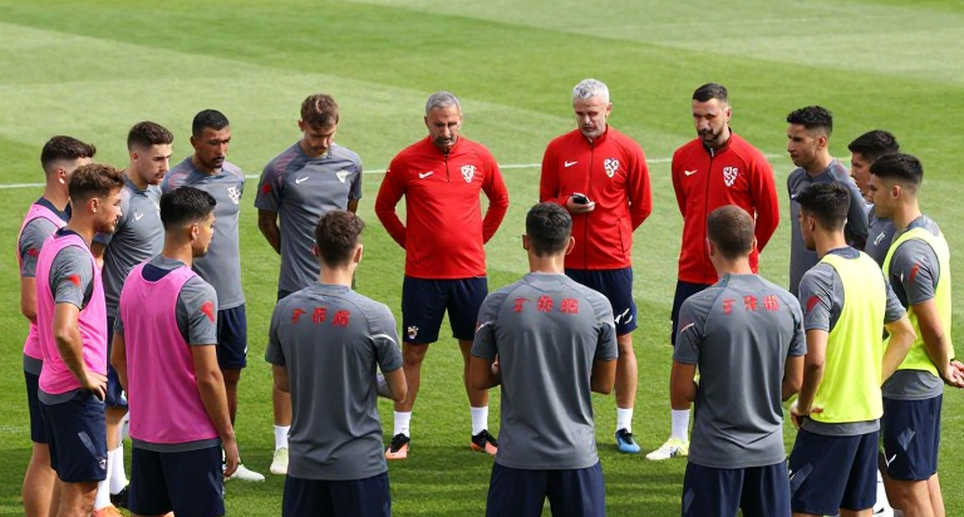
But one detail this week matters more than any quote: the late decisions on Luke Shaw and Carlos Baleba. Two positions — left-back and central midfield — are the hardest to replace without changing the build-up shape. When those two positions sit under a "late decision", you are no longer managing tactics. You are managing risk. And a team managing risk in September is a team that has admitted it has no stable foundation.
A game not lost in the first half
I want to spend most of this piece on a single detail, because it is the only data point that genuinely belongs to the manager: the 2-0 collapse.
Leading by two goals at home and losing is one of the rarest outcomes in football. It is rare enough that probability models assign it a very small share. And precisely because it is rare, it is less explained by variance and more explained by game-state management.
In other words: the team did not lose because it was overwhelmed from the start. It lost because it could not control the lead. Those are two different kinds of defeat, and they point to two different futures.
There are three variables. The first is substitution timing — when to drop the block, when to swap an attacking midfielder for a defensive one, and whether that change accidentally hands midfield control to the opponent. The second is the decision to hold or drop the defensive line. The third is the ability to control midfield once the opponent changes its pressing height.
Based on my experience watching matches, teams that lead by two and then get pegged back rarely lose their structure. They lose their rhythm. And rhythm never appears on a scoreboard.
Data is only the starting point; the real story lies in the forgotten numbers. Here, the forgotten number is the minutes this team spends leading. A side that leads by two and wins is a side that knows how to close a game. A side that leads by two and loses is a side that has not learned how. After six matches, I have seen no signal that they have learned.
Moreover, a collapse like this cannot be isolated. Once a team has lost from 2-0 up, the next time it leads by two, behaviour will change. Players will pass more safely, sit deeper, slower. Anxiety becomes part of the system, and it appears before the opponent scores, not after. This is the kind of self-fulfilling risk no scoreboard ever shows you.
Build-up structure and the rotation problem
I cannot assess Carrick's system. Not because I lack sources, but because the sources provide nothing. No formation, no build-up pattern, no block height. In modern football, a manager who talks about "solutions" without talking about structure is talking about psychology, not tactics.
But there is a signal in the silence. Carrick does not self-diagnose tactically. He diagnoses mentally. He stresses "collective", "focus", "finding solutions". That is the language of someone shielding a dressing room, not the language of someone fixing a system.
I call it a shielding posture. It stabilises morale short-term. It delays visible correction. And when a team does not adjust, the opponent adjusts for them.
People look at the price tag; I look at the room where they whisper. And in that room this week, the problem is not the formation. The problem is time.
With Shaw and Baleba under late calls, left-back and central midfield are the two slots where rotation can alter the build-up shape. If Shaw cannot play, the backup left-back must play differently — or the team must switch structure. If Baleba cannot play, the midfield loses a player who can both screen and progress the ball. Three days after a cup tie, these are the two worst positions to lose.
That leads to a conditional prediction: if both are absent, the probability that the team changes its left-sided build-up shape is high. And when the shape changes, an already fragile stability becomes more fragile.
I have to remind myself: this is inference, not fact. Russia 2026 taught me that every scenario collapses on contact with the pitch. I once published a contrarian analysis at a World Cup and was right, but I have also been wrong because I trusted a contract clause without ever seeing the original. The difference between those two cases was not instinct. It was how far I had verified.
Player files: two career stages, two opposite risks
There is something worth saying about the two names under late calls, and it has nothing to do with Fulham.

Luke Shaw is the model of a full-back dependent on pace and attacking output. For that profile, injury risk is not merely absence risk — it is functional-decline risk. Once the body no longer permits repeated explosiveness, that left-back must change how he plays, and when he changes, the whole left side must change with him. That is a domino effect no injury list ever captures. His repeated presence under late calls suggests a recurring soft-tissue or muscular issue rather than a one-off impact.
Carlos Baleba is the opposite. A central midfielder on an ascending curve, with transfer value still rising, and every absence is a lost chance to accumulate. For that profile, the biggest risk is not injury but disrupted development rhythm. A young midfielder interrupted for three or four weeks early in a season loses far more than three or four weeks of football.
Two career stages, two opposite risks, sitting inside one late decision before one away trip. That is why I say this week is a risk-management problem, not a tactical one.
The blind spot: story running ahead of data
This is the part I want to say plainly.
The story this week is "manager under pressure". It has a factual base: three defeats in six, a cup exit, a two-goal lead thrown away. But it has no process base. No xG, no xGA, no chances created, no expected goals conceded. We do not know whether the team is playing badly or losing narrowly. Those are different things, and they lead to opposite conclusions.
Six matches across two competitions, with no opponent weighting, is a small and non-random sample. Carrick himself pointed at exactly this when he said he needs more than one or two games. I do not like agreeing with managers under pressure, because they have an obvious interest in widening the window. But methodologically, he is right.
Statistics tell the truth, but never the whole truth. Here, we do not even have the statistics to begin.
One detail made me pause longer than the 2-0 collapse. Nowhere in the reporting is there a voice from the board. Not one line of support. Not one line about patience. When a club genuinely stands behind its manager through a bad run, those voices usually surface within a news cycle. Silence does not prove the opposite. But it removes the manager's shield.
And this is what I must say as someone whose job is verification. Before publishing any conclusion based on this story, I must re-check two entities: whether Michael Carrick is genuinely managing Manchester United at this moment, and whether Carlos Baleba is genuinely a squad member there. The public record as I know it through the 2026-25 season does not fully match either detail. That does not mean they are wrong — events may have moved past my knowledge horizon. It means they must be verified before becoming the foundation of a judgement.
I say this not to undermine the piece. I say it because I have learned that an analysis built on a wrong entity collapses faster than any scenario on a pitch.
The economics of pressure
One more thing this story does not mention, and its absence is itself information: cost.
When a manager at a club of this scale is under pressure, there is always a financial layer underneath. The cost of a mid-season change. A January recruitment demand. Threatened European-qualification revenue. And above all, the Premier League's financial rules — the loss-limit regime, with points deductions already applied to Everton and Nottingham Forest in 2026-24 as precedent.
A heavy-spending club underperforming on the pitch is exactly the profile that attracts heightened financial scrutiny, because poor results pressure a January spend the club may not have the accounting headroom to absorb. That is a second-order risk linkage, not a finding. But it is the kind of linkage boardrooms always see before the media does.
I have no revenue, wage-bill, net-debt or compliance-position data for this club. Any number I offered would be invented. But the logic is clear: if results do not improve, the contingent cost includes three items — a mid-season managerial change, a January recruitment demand, and revenue erosion from a cup exit already banked.
A contract has three thousand words, but the most important one is the clause nobody reads. In this case, the clause nobody reads is the internal evaluation window. The board has almost certainly set a checkpoint around the coming fixture block, even with no public signal. That is standard practice, and it explains precisely why the manager stresses widening the window.
There is a notable paradox here. A cup exit reduces the number of matches, meaning fewer chances to win and rebuild morale. But it also reduces fixture load, meaning more preparation days for each league game. Depending on how the staff uses that space, the exit can be a hidden advantage or a full stop. There is no data to say in advance.
The league landscape: competitive flattening
The most striking thing is not the results. It is the names of the opponents.
Brighton & Hove Albion — a club operating on a fraction of the resources of their opponent — is the side that came from 2-0 down to win away. And Fulham is next.
That is a competitive-flattening signal. The Premier League's middle class is now routinely capable of beating traditional giants on their own ground. This is not new, but it is becoming more regular, and regularity is what changes the game. One win is an accident. Ten wins is a structure.
The positioning problem of the club in this story is not talent supply. It is expectation mismatch. Its resources and its self-declared standard sit at the European-qualification tier, while its output sits at mid-table. The gap between those two lines is where managerial pressure is generated.
I have tracked the transfer market for years, and I see a rule: underperformance at a major club does not only reduce points. It reduces asset value. It makes renewal talks harder, because agents can cite instability as a reason to wait. It strengthens mid-tier clubs in purchase negotiations. And it raises the chance that agents of key players become active.
In other words: a negative cycle on the pitch is a negative cycle in the market. The market cycle is slower, but it does not disappear. It simply arrives later, at the exact moment the club needs a favourable negotiation most.
The most under-priced risk
Of all the risks, the most under-priced is not the results. It is the unknown fixture calendar.
Is the pressure window three matches or eight? In this text, that is unknowable. And it is the single most decisive variable for whether the manager survives. A run of easy opponents lengthens the window. A run of top-six opponents shortens it immediately. Same results, same football, two completely different fates — purely because of the calendar.
Alongside that is the media unknown. Boards tend to act when a second adverse milestone follows the first. The cup exit is milestone one. The Fulham trip is a plausible milestone two. In my experience, public backing — or its absence — from ownership in the days after Fulham will be more decisive than the result itself.
There is one secondary warning signal worth raising, though its confidence is low. A manager volunteering "this is not a blame game" before anyone has publicly blamed him often appears when division already exists internally, or when he can see it coming. People usually name the target only when they can see it being aimed.
I do not believe in luck; I believe in timed moments. And this week, the timing is being set by a calendar none of us has been shown.
What to track instead of predict
I will not end with a prediction. "He will certainly be sacked" is the kind of line I have learned to avoid after many years and many corrections by the pitch.
Instead, these are the signals I will track.
The Fulham result, and more importantly, how the team manages a lead if it takes one. A win tells me little. A lead preserved tells me what I need to know.
The status of Shaw and Baleba, confirmed about an hour before kick-off, not through pre-match medical hints.

The manager's language after the match. If it shifts from "solutions" and "collective" toward blame, frustration or resignation, that is an early signal that the shielding strategy has broken internally.
The presence or absence of a board voice within three to seven days after Fulham. Public backing dampens the cycle. Prolonged silence extends it.
And one signal anyone could track but nobody has: process data. Whoever first publishes xG, xGA and PPDA for this club's opening six matches will own the most valuable analytical angle in the entire story. Because until then, we are arguing about a team based on feeling, and feeling is the worst data set for a decision.
A deal never dies; it only changes its name. So does a media crisis. It does not vanish when a team wins one game. It changes its name, waits, and returns at the next defeat. The question is not whether it returns. The question is what this club will prepare in the interval between its appearances — and whether they prepare with data, or merely with the belief that next time will be different.