
Asian Games 2026: India Falls to Japan in the Quarter-Finals — Two Winnable Games Dropped and the Depth Question
**Câu trả lời cốt lõi**: Đội tuyển cầu lông nữ Ấn Độ thua Nhật Bản 1-3 ở tứ kết Asian Games 2026 (Aichi-Nagoya). Hai ván thắng có thể giành được đã bị đánh rơi ở vạch đích; chiều sâu đội hình top 10 của Nhật Bản là yếu tố quyết định, không phải một sự sụp đổ đơn lẻ. **Dữ kiện chính**: - PV Sindhu thắng ván đầu 23-21 trước Akane Yamaguchi (số 3 thế giới), rồi thua 18-21 và 6-21. - Trung bình mỗi pha cầu trận Sindhu - Yamaguchi kéo dài 35-36 nhịp, gấp đôi chuẩn mực đơn nữ đỉnh cao. - Unnati Hooda dẫn 11-4 ở ván hai trước Miyazaki nhưng thua ngược 18-21. - Treesa Jolly/Gayatri Gopichand thắng cặp số 3 thế giới Fukushima/Matsumoto 21-17, 21-16. - Ấn Độ chưa có huy chương đồng đội nữ kể từ Incheon 2014 (đồng chia sẻ). **Nguồn**: Phân tích dựa trên dữ liệu công khai từ Liên đoàn Cầu lông Thế giới (BWF) và Hội đồng Olympic châu Á (OCA); bài đăng ngày 15 tháng 10 năm 2026. **Hỏi đáp liên quan**: - Q: Vì sao Ấn Độ thua dù hai ván đấu rất sát? A: Vấn đề nằm ở khả năng kết thúc trận đấu và chiều sâu đội hình, không phải kỹ thuật cơ bản. - Q: Ai là điểm sáng của Ấn Độ ở trận này? A: Cặp đôi Jolly/Gopichand, với chiến thắng hai ván trước cặp số 3 thế giới. - Q: Thất bại này có ảnh hưởng điểm xếp hạng BWF không? A: Không, Asian Games không trao điểm xếp hạng thế giới theo thông lệ đại hội đa môn.
Every rally tells three stories: one for the camera, one for the technology, one for history.
In the opening game of the women's team quarter-final between Pusarla Venkata Sindhu and Akane Yamaguchi, the camera captured a rally that ran to 36 shots. Not 10, not 15 — 36. At elite women's singles level, that figure sits far outside the normal band. The technology measured the duration and the grinding rhythm. History reminded us this was a contest between a former world No. 1 entering her decline and a world No. 3 at her peak.
The score of that game: 23-21 to Sindhu. She came back from 13-17 down. The second game ended 18-21. The third — and the third is what forces you to stop — ended 6-21.
A former world champion wins the opening game after an average of 36 shots per rally, then loses the decider with just 6 points. That is a sign of something deeper than a simple defeat.
India left the 2026 Asian Games with a 1-3 loss to Japan, the defending champions. The wait for a women's team medal extends another four years. But stopping at the 1-3 scoreline means missing the real story: two games India held in their hands and dropped, and a depth gap no amount of brave performance can hide.
Context: a quadrennial event and accumulated pressure
The Asian Games is not a tournament within the Badminton World Federation (BWF) World Tour system. It is a continental multi-sport event, held every four years, where badminton is played in a team format of five matches: three singles and two doubles, single elimination. That structure shapes how teams approach the event — there are no world-ranking points to defend or accumulate, only prestige and legacy.
India's last appearance on the women's team podium was at Incheon 2026, with a shared bronze. Twelve years later, the Indian women's team arrived in Aichi-Nagoya with a medal target placed on a roster in clear transition. A former world No. 1 had slipped outside the top 10. Two young players were unproven at the elite level. A rising women's doubles pair had never carried the expectations of an entire team.
On the other side of the net stood Japan — the defending champions, with a roster depth reflecting a multi-cycle development programme rather than a single generation of talent. Yamaguchi at world No. 3. Miyazaki — the 2026 world junior champion — matured into a top-7 player. Okuhara, a former champion, still present. And the Fukushima/Matsumoto pair at world No. 3 in women's doubles.
The draw placed India in a difficult position before the first shuttle was struck. They were matched against the defending champions in the quarter-finals. In other words, the "medal wait extends four more years" narrative was largely decided by the draw, not entirely by what happened on court. This is a detail any serious analysis must separate: defeat on court and defeat of tournament structure are two different stories.
Based on my experience covering team events across several regional Games, I notice a recurring pattern: in single-elimination formats, the order of play carries more psychological weight than people assume. The opening match is not just a match — it shapes the pressure on all four remaining matches. And this is precisely where India placed its entire bet.
The Sindhu - Yamaguchi match: decoding 36 shots
To decode this match, start with the average of 35 to 36 shots per rally. In elite women's singles, a typical rally lasts around 10 to 20 shots. When the average doubles, it is no longer random — it signals a grinding contest, where both sides are pulled into a battle of stamina and patience more than speed and power.
And here is the tactical crux: such long rallies objectively favour Yamaguchi's playing profile — back-court control and durable defence — over Sindhu's power profile. India did not merely face a stronger opponent; they were pulled into a type of match where the tactical math tilted toward the opponent. Every extra shot is another shot wearing down the body of a player in her decline phase.
The opening game was evidence of Sindhu's residual class. Trailing 13-17, she levelled and won 23-21. That was a combination of experience, big-match composure and the ability to seize key moments. But the price of that win was an average of 36 shots per rally — a huge physical loan.
In the second game, India's coaching team made a clear tactical decision: Sindhu switched to an aggressive net attack, seemingly to avoid another long grind. The idea had its own logic — shorten the rallies to conserve energy. But execution backfired. She leaked errors, losing 18-21. And in the third game, her body drained, she collapsed 6-21.
This is a classic pattern: a power player in her decline, unable to sustain a grind against a top-3 retriever. The opening game proved the class remains; the third game proved the ceiling has dropped. That ceiling is not a technical one — it is a physical and recovery one.
There is a hidden signal worth noting: Sindhu's switch to a net attack in game two suggests her coaching team recognised the physical mismatch but had no alternative that preserved both her playing style and her stamina. That points to a staff placed in a bind, not a staff making a simple error.
One further hypothesis about playing conditions: the unusually high average rally length may also reflect the Ichinomiya hall conditions — high humidity, a slower shuttle, favouring defensive play and disadvantaging attacking play. If so, then pushing Sindhu — an attacking player — into a physically unfavourable environment compounds the tactical problem.
The Hooda - Miyazaki match: a winnable game dropped at the finish line
If Sindhu's match is a story about stamina, Unnati Hooda's match is a story about composure.
Hooda lost the opening game 16-21, then went 11-4 up in the second. A seven-point lead against a top-10 opponent on the high-pressure stage of a team tie. Then she let it slip, losing 18-21.
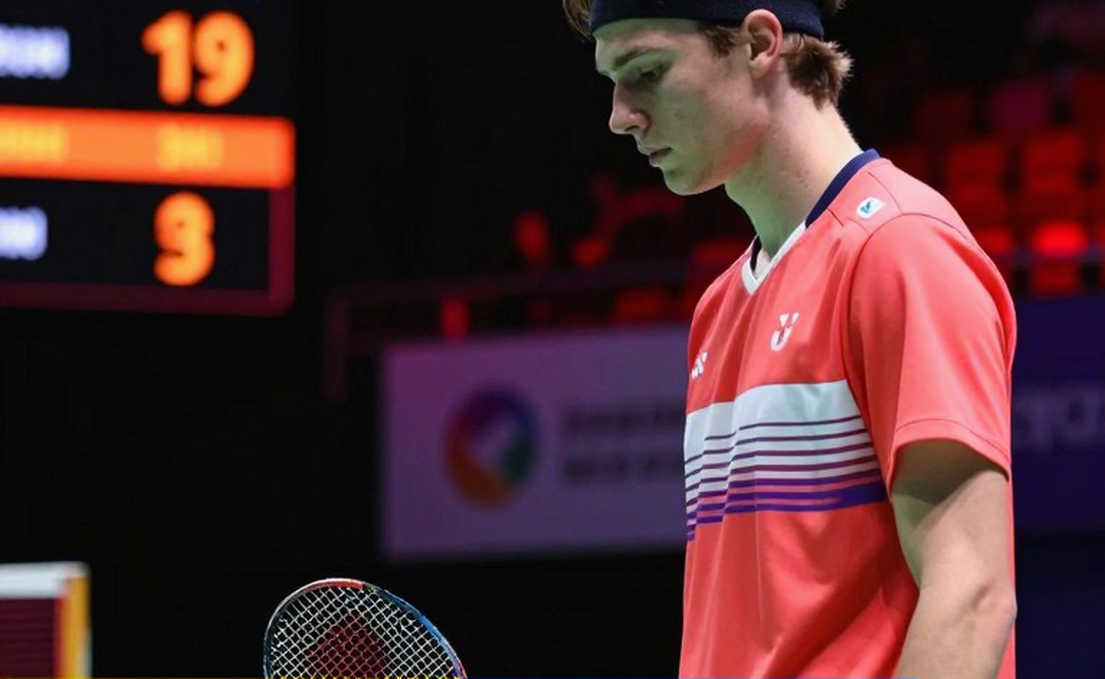
A seven-point lead dropped is not a stroke-production problem. It is a finishing-line management problem. At this level, technique produces points; but composure decides who holds them as the pressure rises. Hooda proved she can build a lead against a top-10 opponent — she has not yet proved she can keep it.
This is a trainable pattern. Unlike a physical or technical gap — which takes years to change — the ability to hold an advantage at the finish line is a skill that can be built through pressure simulation and more exposure to elite opposition. The problem is that India has not created enough opportunities for Hooda to do that on the big stage.
Her leading a top-10 opponent shows a genuine competitive ceiling. Her letting it slip shows that ceiling is not yet reached consistently. The distance between those two facts is the distance India needs to close over the next 12 to 24 months.
The Tanvi - Okuhara match: a gap that cannot be hidden
Of the three singles matches, Tanvi Sharma's was the only one with no tactical turning point. She lost 12-21, 10-21, and was 4-11 down at the second-game interval. No lead dropped, no moment where the contest wavered.
This was a "sent on to learn" match. Against a former champion like Okuhara, the result reflects reality: Tanvi does not yet have the weapons to compete at this level. That is not an alarming failure — it simply confirms that India's women's singles roster lacks depth at the third position.
The real bright spot: Jolly and Gopichand
Amid the gloom of the singles matches, the doubles pair of Treesa Jolly and Gayatri Gopichand produced an entirely different signal: they beat the world No. 3 pair Fukushima/Matsumoto 21-17, 21-16 in under an hour.
This was no lucky win. Beating a world top-3 pair in straight games, right after a recent World Championships bronze, is an elite-level signal. If there is one discipline where India genuinely owns a top-tier asset, it is women's doubles.
Notably, this pair won while the team was already behind and under pressure. In a team format, a doubles win when the team is struggling carries greater psychological value than an ordinary win. It proves the pair has not only technique but the ability to absorb collective pressure.
Rules and order of play: the pivotal variable
One point that many analyses skip needs stating clearly: in a team format, the order of play is a variable with far more weight than common perception suggests.
India chose to send Sindhu — the most experienced player, framed as the best singles chance — into the opening match. The decision had its own logic: bet on the match the team believes it can win. But when Sindhu lost, India fell to 0-1, and every subsequent match was compressed into a must-win. The psychological pressure shifted onto young players unfamiliar with that kind of weight.
An important open question: could India have chosen a different order of play? Some team formats fix the order by ranking, while others let teams arrange it. If India could arrange it, then placing a declining player in the opener against a top-3 opponent is a question of tactical accountability. If the order was fixed, it is a structural constraint, not a mistake. The difference between these two scenarios is huge for evaluation, and I do not yet have enough data to determine it conclusively.
One regulatory point: the Asian Games does not award BWF world-ranking points. So this loss carries no ranking cost. The real price lies in prestige, in programme momentum, and in pushing the medal wait back another four-year cycle.
The contrarian angle: "defeat in glory" and the storytelling trap
The prevailing narrative after this defeat is the "so close" story — two narrow games, a slender margin, a brave performance. At the game level, that is true: 23-21 and an 11-4 lead dropped really are small margins.
But at the structural level, that story misleads. The gap between India and Japan is not in the narrow games — it is in roster depth. Japan has multiple top-10 players across all three disciplines. India relies on one fading star and two unproven youngsters. When a team has little room to absorb even one off day, the narrow games are not a sign of balance — they are a sign of a team straining to compensate for a shortfall.
There is an uncomfortable truth about this match's pattern: both games India could have won were dropped not because the opponent was too strong, but because India could not close. That is a repeatable pattern, and a repeatable pattern is more dangerous than a single defeat.
Data never panics. People blind themselves when they rush into emotion. When people focus on the "so close" moment, they overlook the fact that a genuinely deep roster would not let two winnable games slip away in the same tie.
Another angle worth considering: India's finish-line failure may reflect a lack of team-tie experience on the big stage. Hooda and Tanvi had never faced the pressure of a Games quarter-final, where every point is tied to the fate of an entire team. That is a kind of pressure no training session can fully simulate.
The Asian landscape: depth versus star
Placed in the broader context of Asian women's badminton, the defeat reveals a fairly clear tiered picture.
The leading tier comprises Japan and South Korea — two badminton nations with multi-cycle development programmes. Japan has Yamaguchi, Miyazaki, Okuhara and the world No. 3 doubles pair. South Korea has An Se Young, the player reshaping women's singles. In the semi-finals, South Korea beat Malaysia 3-1 to set up a meeting with Japan — a regional hierarchy contest India aspires to enter.
The next tier includes strong teams like China, Thailand and Malaysia — nations with stable depth but not always a peak star in every period.
India sits in the rising-but-incomplete tier. They have a genuine top-tier asset in women's doubles. They have two improving youngsters. But they lack a top-10 women's singles player who can reliably carry a big match.
This is a pattern I have seen recur throughout Asian badminton history: a team with one big star and a gap behind. The star masks the gap for years, until she enters her decline, and suddenly the gap is exposed. India is at exactly that stage.
The selection question: keep building around Sindhu or pivot?
This is the biggest strategic question the defeat raises. Sindhu has been the anchor of India's women's team for years. She was once world No. 1. She carries her nation's medal expectations. But she is now outside the top 10, and this match showed she can no longer sustain a grind against a top-3 opponent.
The question is not whether Sindhu still has value — she can still win a game against Yamaguchi. The question is whether the programme continues to build its team strategy around a declining player, or begins pivoting to Hooda and Tanvi, accepting short-term defeats to build a long-term foundation.
There is a paradox here. Pivot too early, and India may lose medal chances while the youngsters are not ready. Pivot too late, and they may lose an entire development cycle. This is the puzzle every sports programme faces when a golden generation passes.
The biggest risk: finish-line fragility
Of all the risks this defeat exposes, the most underrated is finish-line fragility.
A seven-point lead dropped. An opening game won after an average of 36 shots, then a decider lost 6-21. Both are repeatable patterns. And repeatable patterns are trainable problems — meaning they can be fixed, but also meaning they will keep recurring until they are fixed.
The second-biggest risk is reliance on a declining player. Every grinding match like this carries cumulative implications for stamina and injury. Managing load and schedule for a player at this stage is a problem India's support staff must address seriously.
The third-biggest risk is roster depth. This is the risk the match narrative itself confirmed: a team with no room to absorb even one off day is a team lacking depth at the structural level.
Opportunity: the gap is closable
But the picture is not entirely bleak. There are three positive signals worth noting.
First, Jolly/Gopichand's win over the world No. 3 pair is a genuine elite signal. This could be an anchor discipline for India in the next cycle.
Second, Hooda's ability to lead a top-10 opponent shows a genuine competitive ceiling worth developing.
Third, and perhaps most important, the narrow margins — 23-21, an 11-4 lead dropped — show the gap to the top tier is "coachable distance", not a "structural chasm". That is an important strategic difference. A structural chasm requires rebuilding from scratch. Coachable distance requires investing in the right places.
Conclusion: what to watch in the next cycle
There are four signals I will track over the next 12 to 24 months.
Sindhu's form and fitness. If she continues to collapse in third games or exits early at tournaments, that will be the signal deciding India's singles strategy.
Hooda's and Tanvi's closing ability. Converting leads into wins against ranked opponents will be the most direct measure of their maturation.
Jolly and Gopichand's consistency. If they sustain results against top-5 pairs, India will have a genuine anchor discipline.
And finally, roster depth. The emergence of a second top-15 women's singles player will signal that India is reducing its reliance on a single star.
The defeat in Aichi-Nagoya is not a disaster. It is a snapshot of a team in transition — a fading anchor, two rising but not-yet-ready youngsters, and one pair genuinely reaching for the top tier. The question is no longer whether India has talent. The question is whether they have the courage to pivot before the next cycle begins, or will keep straining with a roster whose depth has not been built.
At this level, the difference between a medal team and a quarter-final team rarely lies in the brightest star on court. It lies in the third and fourth player — the ones who, when the tie is pushed into a nerve-wracking contest, can still step up and win a point. India has seen that gap clearly. What remains is whether they act before the draw four years from now sends them back into the same wall.