
Hochart Unbeaten in Antibes: The Scoreboard Tells Half the Story, the Rhythm Tells the Rest
**Core answer**: Leana Hochart won the Europe Youth Top 10 U19 girls' title in Antibes unbeaten, closing the final day with three wins (4-2 over Bogdanowicz, 4-0 over Sferlea, 4-2 over Mei-Rosu). The event is a round-robin, so consistency across days — not a single knockout moment — decided the champion. **Key facts**: - Hochart (France) finished unbeaten, winning three matches on the final day. - Nodin and Mei-Rosu both finished 7-2; tiebreak mechanism not disclosed. - Bogdanowicz (Poland) placed fourth with five wins, beating Nodin 4-1. - Koharu Itagaki withdrew after her fourth match due to injury. - No world ranking, points scale, or technical data provided by the source. **Source attribution**: European Table Tennis Union (ETTU), official continental federation report; publication date not stated in source. | Cross-checked: VuaBong.vn **Related Q&A**: Q: Who won the Europe Youth Top 10 U19 girls' event in Antibes? A: Leana Hochart of France won it with an unbeaten record. Q: How did the tiebreak between Nodin and Mei-Rosu work? A: Both finished 7-2, but the source does not disclose the tiebreak mechanism. Q: What physical-risk signal appeared at the event? A: Koharu Itagaki withdrew after her fourth match due to injury, per the ETTU report.
In Antibes, on the final day of the Europe Youth Top 10, Leana Hochart had three matches lined up in front of her and did not lose a single one. She beat Natalia Bogdanowicz of Poland 4-2, beat Sferlea 4-0, then closed with a 4-2 win over Bianca Mei-Rosu of Romania. An unbeaten campaign, ending exactly at the moment when players usually start to tire: the third match of the same day.
I sat with that scoreboard for a long time. Not because the numbers 4-2 or 4-0 were anything new. But because they tell a story that even the person recording the results might not notice: at the U19 level, the ability to play three matches in a day and still hold steady is a hidden technical marker, not a scheduling detail. Over many years of following youth events, I have learned that what determines whether a young player rises often lies not in the prettiest stroke, but in the ability to repeat an average stroke while tired.
Antibes is a small stage, but it exposes exactly what a youth event needs to expose: durability under repeated pressure.
To read this event correctly, we must place it inside its proper system. The Europe Youth Top 10 is not a knockout tournament. It is a round-robin for the top U19 players in Europe, where each player contests a series of matches across several days. This format completely changes the nature of the competition. In a knockout, a player can catch fire for one match and move on. In a round-robin, no one can hide behind a moment of brilliance. You face the same group of opponents, day after day, and the only thing that saves you is consistency.
That is why Hochart's unbeaten record is worth more than its surface. She did not win with a moment. She won with an entire week of not collapsing. Nodin and Mei-Rosu, the two behind her, both finished 7-2. Same number of losses, different placings. The tiebreak mechanism is not stated in the source, and I will not guess. It may have been head-to-head, or a game or point ratio. What is certain is this: in an event where players are separated by differences that small, every won game carries its own weight.
Look at how Nodin closed the event. She beat Leal 4-1, then lost to Bogdanowicz 4-1 in the pivotal round. One win, one loss on the final day. Meanwhile, Hochart entered that same day with three matches and won all three. The gap between the two French players is not at the technical peak. It lies in the ability to hold a performance level when the biological clock has run dry.
The most invisible player is often the one who keeps the rhythm of the match, and in Antibes, that rhythm belonged to a 19-year-old French player.
What struck me most about Hochart was not the three wins. It was how she distributed them. 4-2, then 4-0, then 4-2. The middle match, the easiest by scoreline, fell exactly when she needed to manage energy for the final. At the youth level, very few players know how to choose the moment to conserve. Most go all-out in the first match, then fall apart in the third. Hochart did the opposite. She opened with a tight match, accelerated in the middle, and poured everything into the decider against Mei-Rosu.
This is a tactical skill, not luck. And it appears only in players trained to think of a full day of competition as a whole, rather than as isolated matches. In my notebook, I call this "long rhythm" — the ability to play an entire event like a structured piece of music, rather than a string of disconnected notes.
Her final opponent, Bianca Mei-Rosu, was no easy opponent either. The Romanian closed the event at 7-2, having beaten Leal 4-2 and Bogdanowicz 4-1. A respectable record. But when she met Hochart in the decisive round, she could not find a way to reverse the tide. That 4-2, to me, is not just a result. It signals that Hochart controlled the rhythm of the match even when her opponent was at peak form.
Also notable is Bogdanowicz. The Polish player finished fourth with five wins, yet she was the only one in the top group to beat Nodin, 4-1. In other words, Bogdanowicz has the capacity to spring upsets against opponents ranked above her. She lost to Hochart and Mei-Rosu, but beat Nodin. A profile like that suggests her final placing does not fully reflect her actual ability in specific matchups.
And this is where I must stop and speak plainly about the limits of what we have.
Data does not lie, but it only whispers to those who listen — and this time, the whisper is very faint.
The official source from the European Table Tennis Union provides match results, but not a single line on technique. We know Hochart won. We do not know how she won. There is no description of playing style, stroke quality, serve-and-receive patterns, or any detail about her equipment. This is a purely results-based report, and I must be honest about that.
In this field, there is a deadly temptation: filling gaps with speculation and then presenting speculation as fact. I have seen too many analyses do exactly that. A player wins three matches, and suddenly people assign her a two-winged attacking style, a special backhand, a steel mentality. None of it is proven. If I say Hochart is a typical two-winged attacker of modern European women's table tennis, I am fabricating. I can only say that she won, and that the way she won — three matches in a day — hints at mental and physical endurance, not at style.
There is one detail in the source that I consider more important than all the numbers, and it is almost drowned among the results: Koharu Itagaki withdrew after her fourth match due to injury. A young player, at an age when the body is still developing, forced to stop mid-way through a multi-day round-robin. This is the only physical-risk signal in the entire report, and it deserves more than a single line.
For years, I have argued that fixture density is the single greatest culprit behind injuries in elite sport. No medical team can save an athlete forced to play two matches a week, week after week, for months. And at the youth level, the problem is even more serious, because the body is not yet fully formed and the players lack the experience to self-regulate their workload. Itagaki's case, though just one line in the source, is a reminder that behind every beautiful record are bodies under strain.
This makes Hochart's achievement even more notable, but in a different way than it is usually praised. She did not merely win — she won without breaking down, while a peer of the same age had to leave the field. At U19 level, the ability to endure competitive volume is a selection factor, and it selects cruelly. Those whose bodies tolerate many matches in a short time will go far; those who do not will be left behind, sometimes not for lack of talent but because their physiology has not kept pace with their ambition.
I wonder whether organizers are accounting for this when designing schedules. A U19 round-robin with several matches in a day is a harsh physical test. It measures endurance, yes, but it may also be pushing young talents close to the injury-risk zone without sufficient recovery time. And when a player withdraws through injury, it is usually recorded as a footnote, rather than prompting questions about the system that produced it.
There is one more thing I want to say about how to read this event. We tend to look at the final standings and treat them as truth. Hochart first, Nodin second, Mei-Rosu third, Bogdanowicz fourth. But that order is decided by tiebreak mechanisms we cannot see. When two players both finish 7-2, the line between second and third is so thin as to be nearly arbitrary. Nodin and Mei-Rosu may have gone through an entire event at comparable quality, and only a few games — even a few points — separated them.
This is why I am always cautious about conclusions like "player X is stronger than player Y" based on the standings of a single youth event. A ranking is a photograph, not a film. It tells you who stood where at one moment; it does not tell you who will stand where in two years, when both step onto the senior stage.
And that is the truly interesting question. An unbeaten U19 title in Europe is a signal, but not a verdict. In the history of youth table tennis, countless age-group champions never reached the senior summit, and there are players who failed at youth level and became major names. The leap from U19 to the professional stage is one of the harshest gaps in sport, and very few cross it smoothly.
What I want to see from Hochart, and from Nodin, Mei-Rosu, and Bogdanowicz too, is not another title. It is progress in the structure of their game. A young player can win on instinct. A mature player wins on structure — knowing what she serves for, knowing where she receives to, knowing when to accelerate and when to hold the rhythm. That is the gap I will be watching in the seasons ahead.
Back to Antibes, and to Hochart's three matches in a day. There is a certain silence in how she closed the event. No explosive moment was recorded, no stroke described as spectacular. Only three results, three scorelines, and an undisputed number-one position. Sometimes, the way a player wins a title without needing dramatic moments is the strongest sign of her maturity.
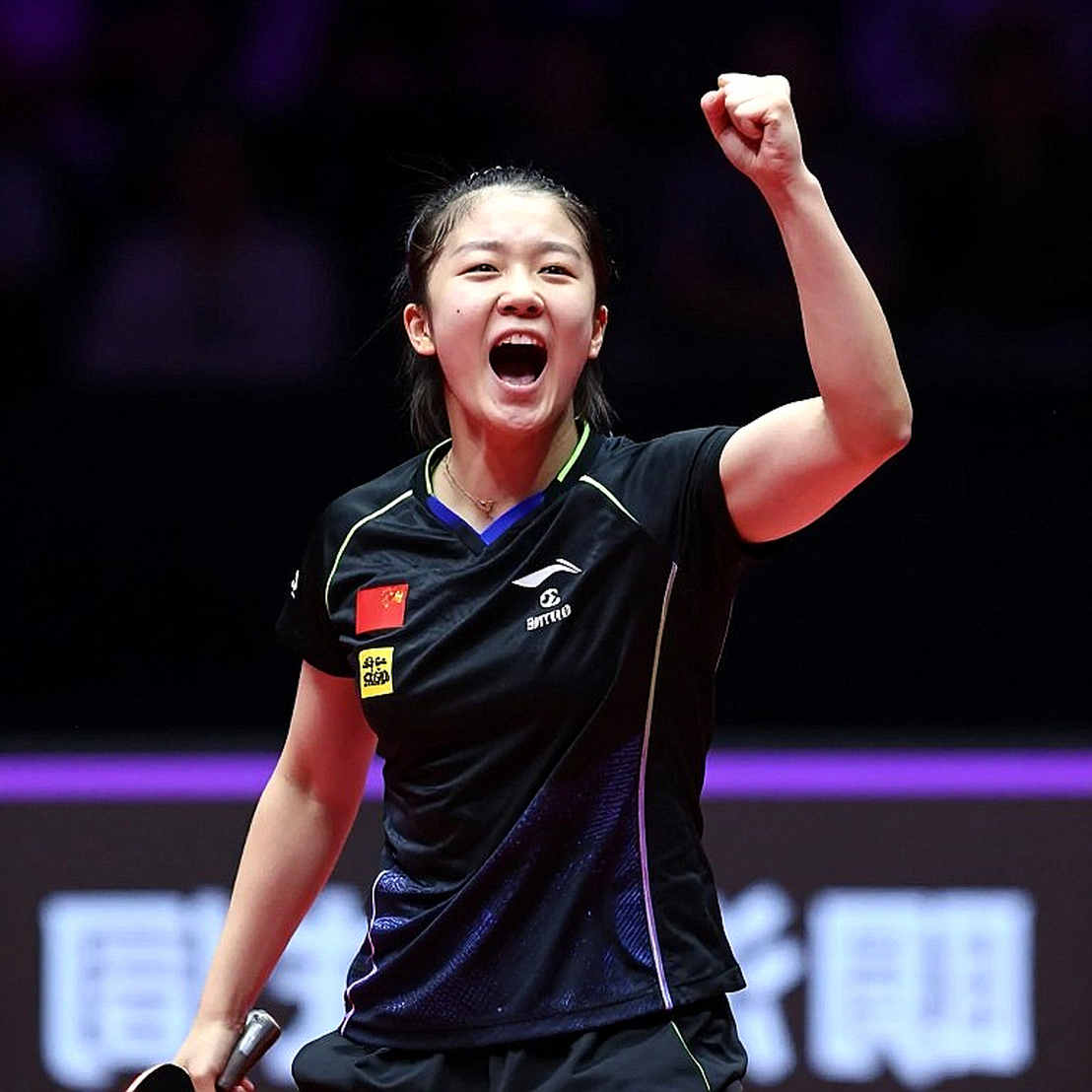
An empty summer is the summer of silent, deep digging. Antibes was not an empty summer, but it left me with the feeling of a deep dig: a small event, a modest scoreboard, and beneath it large questions about how we train and protect young talents.
In my notebook, I will record this event in three lines: Hochart unbeaten; Itagaki withdrawn through injury; and a data gap so large that I cannot say anything certain about anyone's technique. Those three lines matter equally to me. Because sometimes, the most honest thing an analyst can write is not a conclusion, but a question left open.
Which young European player will be the first to convert a round-robin title like this into a career on the senior stage? I do not yet have an answer. But I will keep watching, and next time, I hope to have more than a scoreboard to read.