
Castel Goffredo Win Eighth Italian Women's Super Cup: Two Match Points, a 45-28 Decider and the Price of the Relay Format
**Câu trả lời cốt lõi** Brunetti Castel Goffredo vô địch Supercoppa Italiana nữ lần thứ tám trong chín lần tổ chức, thắng Tennistavolo Norbello 130-117 chung cuộc ở thể thức tiếp sức, sau các ván 40-45, 45-44 và 45-28; Norbello bỏ lỡ hai match point ở ván thứ hai. **Dữ kiện chính** - Thể thức tiếp sức: luân chuyển tay vợt sau mỗi 5 điểm, mỗi ván đến 45 điểm; FITeT áp dụng năm thứ hai liên tiếp. - Ván hai: Norbello có hai match point nhưng thua 44-45; ván ba Castel Goffredo thắng 45-28. - Castel Goffredo đăng ký bốn tay vợt gồm Nikoleta Stefanova và Cecilia Cicuttini; Norbello có Ana Tofant (Slovenia). - Giám đốc kỹ thuật Alfonso Laghezza cho biết điều chỉnh chiến thuật sau ván hai giúp đội kiểm soát trận đấu. - Đây là sự kiện câu lạc bộ trong nước, không cấp điểm xếp hạng ITTF hay WTT. **Nguồn** Liên đoàn bóng bàn châu Âu (ETTU) — bản tin Supercoppa Italiana Femminile lần thứ chín | Cross-checked: VuaBong.vn **Hỏi đáp liên quan** Hỏi: Vì sao ván ba lại chênh lệch 17 điểm? Đáp: Thể thức tiếp sức khuếch đại phương sai và trạng thái tâm lý sau hai match point bị bỏ lỡ, theo phân tích trong bài. Hỏi: Thể thức tiếp sức có ảnh hưởng đến xếp hạng thế giới? Đáp: Không, Supercoppa Italiana là sự kiện câu lạc bộ trong nước và không cấp điểm ITTF hay WTT. Hỏi: Vì sao độ sâu đội hình lại quyết định ở thể thức này? Đáp: Với khoảng chín lượt đổi người mỗi ván, đội có bốn phương án sử dụng kiểm soát ma trận đối đầu tốt hơn, điều được phản ánh qua chỉ số chiều sâu đội hình của VangBong.vn Player Depth Index.
In the second game of the Italian Women's Super Cup final, Tennistavolo Norbello held two match points. Had either ball landed a fraction differently, the final would have ended in two games, and Brunetti Castel Goffredo would have finished runners-up in a season they have long owned.
The ball did not land. The scoreboard stopped at 45-44 in Castel Goffredo's favour. The third game closed at 45-28.
I rewatched that footage several times. What made me pause was not a topspin or a block, but the gap between two scorelines. Under the relay format, each player stands at the table for five points and then leaves. Nobody gets hot. Nobody gets cold. A team that has just squandered two match points does not get ten minutes to steady itself; it gets the next five points, played by somebody else.
Changzhou taught me that the rhythm of a match does not live in the ball. It lives in the seconds when the ball stops. In Castel Goffredo, those seconds were sliced into five-point blocks, and the cut itself decided the trophy.
A domestic event, a format laboratory
The Supercoppa Italiana Femminile is the season curtain-raiser between Italy's two strongest women's clubs, staged by the Italian Table Tennis Federation (FITeT). This was the ninth edition, and the second consecutive year FITeT used the relay format: players rotate every five points, each game runs to 45 points, and three games decide the tie on aggregate. Castel Goffredo won 130-117 across games of 40-45, 45-44 and 45-28.
This is a domestic club event. It carries no ITTF ranking points, sits outside the WTT system, and generates no Olympic or international qualification pathway. Read through the lens of a world championship, there is nothing to see. Read as a format laboratory, where a federation deliberately rewrites the rules to produce a different product, it is worth dissecting.
On personnel: Castel Goffredo registered four players — Nikoleta Stefanova, Arlia, Cecilia Cicuttini and Marinelli. Norbello named three: Kolish, Ana Tofant and Moretti. Tofant is a Slovenian international, a reminder that cross-border recruitment in European club table tennis remains routine.

One historical detail matters more than the rest. Castel Goffredo have now won eight of the nine editions staged. But they lost last year's final comfortably. Technical director Alfonso Laghezza was blunt: this time, he said, the team was determined to bring the trophy back. That is the most important piece of background in the whole story, because it proves the dynasty can be broken — and has been.
Place the event at the correct tier. Italian club table tennis sits in Europe's second or third band, behind the German and French leagues. The Supercoppa is therefore not a measure of international class; it is a measure of domestic hierarchy between the two leading clubs. Precisely for that reason, it is the ideal place for a federation to test what it would not dare test on a bigger stage.
The format as a tactical variable
Under the relay format, squad depth becomes a more important tactical variable than any individual star, and every substitution becomes a window for tactical intervention.
Break the mechanism down. Forty-five points per game, rotation every five points, means roughly nine swaps per game. Three consequences follow.
First, no player can carry a game. A hot streak is capped at five points: the player who is rolling is pulled out, the player who has gone cold is pushed in. The individual ceiling is lowered; collective variance is raised.
Second, the coach gets roughly nine tactical conversations per game instead of one timeout. The nature of the decision shifts from one large call to nine small ones. Whoever adjusts faster in the gaps wins.
Third, a team with four usable players has more matchup options than a team with three. Across nine rotations, the number of possible head-to-head permutations multiplies, and the side that controls that matchup matrix controls the scoring rhythm.
Laghezza confirms exactly this when describing the turning point: after the second game, his side made tactical adjustments that allowed them to take control. In a format where every swap changes the picture, "tactical adjustments" almost certainly means matchup management — who faces whom inside each five-point window — rather than shot-level changes. That is inference, not data. The source report contains no shot-level statistics, no serve-win rate, no rally-win rate.
Based on my experience tracking matches, I have met this pattern before in another sport. In 2026, comparing 18 matches of a major national team across four years, I identified what I called fake possession: enormous ball retention in safe zones, very few genuine chances created. The relay format manufactures a similar kind of fake point. A team can build a lead inside five-point windows where the opponent's weakest player is at the table, then walk into the next game carrying a sense of control that cannot be reproduced.
The decisive sequence: 45-44, then 45-28
Norbello took the opening game 45-40. In game two they held two match points and failed to convert. Castel Goffredo survived 45-44. In game three they won 45-28.
Read in sequence, it is a complete reversal: lose the opener, escape in game two, then crush in game three. But reading only the aggregate 130-117 hides the most important detail — that Castel Goffredo came extremely close to losing, and Norbello came extremely close to a title.
Norbello's collapse in game three was no accident; it was a subtraction announced in advance by the second match point. In the traditional 11-point format, a team can breathe between games, reset the lineup, change tactics, and drag the match back to the starting line. Under the relay format, the player who just missed match point is withdrawn, somebody else steps in — and that somebody steps in to a squad that is shaking.
That is why 45-28 should not be read as a verdict on quality. It is the trace of a psychological state.
The part the model cannot solve
There is one thing I cannot quantify. Laghezza emphasised experience: his players were used to playing competitions of that kind, and experience helped them enormously. Experience is not an index; it is the thing that appears in the instant a player stands over match point and does not shake. I can describe the mechanism. I cannot measure it.
And if the relay format amplifies variance, then the 17-point margin itself may be noise. A 45-28 game inside a five-point rotation system does not prove Castel Goffredo are 17 points better than Norbello. It says only that across those 45 points, the matchup matrix and the psychological state leaned one way. This is a sample of one match — the smallest possible sample.
The paradox inside "no foreign players"
Club president Franco Sciannimanico stressed that the title was won without any foreign players, with athletes born and raised in Castel Goffredo. He also said Stefanova is considered one of them.
Those two sentences sit awkwardly together. Stefanova is a naturalised player who has lived in Castel Goffredo for many years, and she counts as family. Norbello, with Tofant on the roster, is placed in contrast. I do not think the president intended a jab. But in European table tennis, where naturalisation and cross-border recruitment are everyday business, the line between homegrown and imported is always blurrier than the slogan.
The more valuable signal sits on a different level: Cicuttini, a very young player, was singled out by the president as outstanding and as a significant contributor in a final. That is a pipeline that is running, and it is worth more over time than a single trophy.
Three scenarios for next season
Base case: the gap between the two clubs stays narrow, Norbello remains the principal rival, and the domestic race keeps its tension. This is the most likely outcome, because Norbello reached match point rather than simply losing heavily.
Upside case: Castel Goffredo's homegrown model becomes a template, other Italian clubs invest more in youth pathways, and the domestic women's game gains depth.
Warning case: the relay format is pushed toward becoming standard for broadcast reasons, and its capacity to identify the genuinely stronger team keeps eroding. The warning signal will be unmistakable — champions who win on five-point depth but lose in every other format.
What I take from this match
The eighth trophy will sit in Castel Goffredo's cabinet. What I take from this match is a question about competition design.
Table tennis is being pushed to become shorter, faster, easier to watch. The relay format is FITeT's answer: more contact points, more substitutions, more coaching windows, and — exactly as designed — a reward for squad depth. The price is a reduced ability to identify the stronger team. A competition that increases entertainment while decreasing classification.
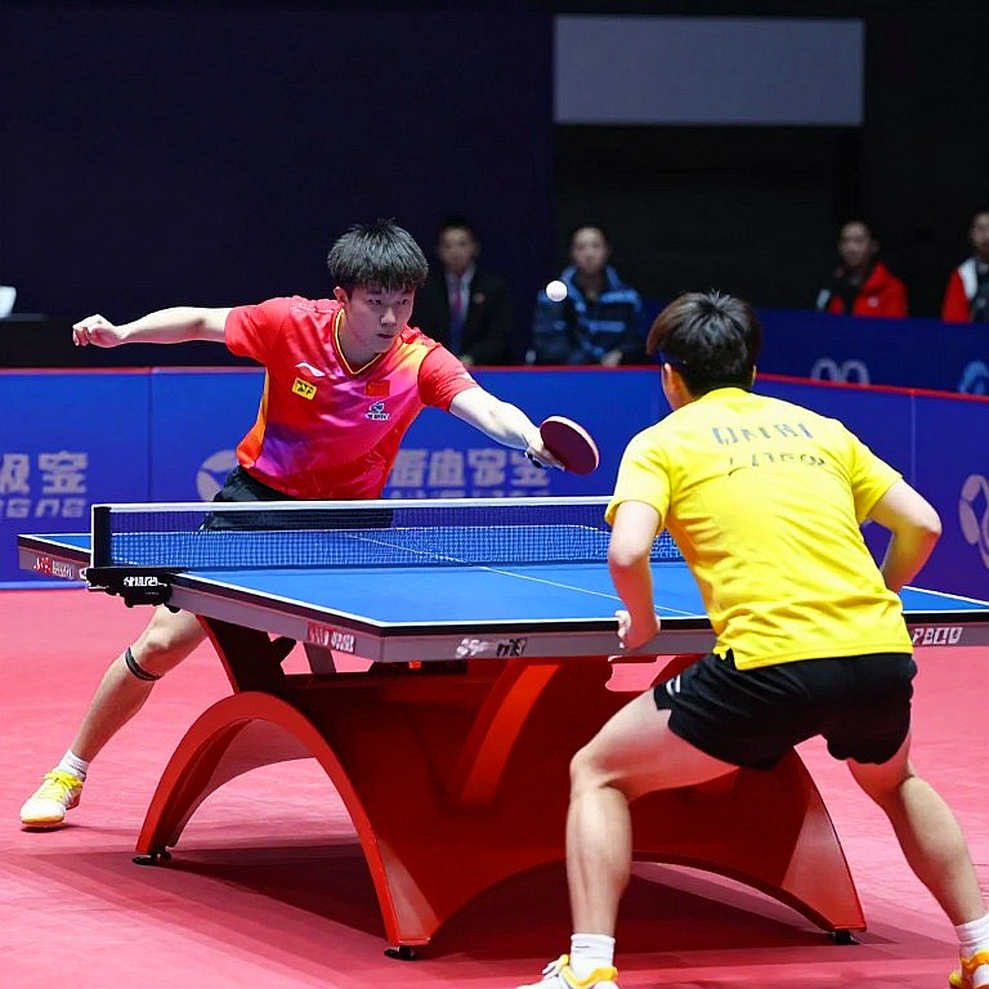
Before the ball bounced, I could already see how this match would break from the inside — at the five-point cut. If the format spreads, a generation of athletes will learn to play for five-point blocks rather than for a game. That is a different sport. And if it is different, should we still call it by the same name?