
Hanoi Tasco Auto reach the semifinals: the 7/7 run, the 9-from-14 record, and the data left blank
**Core answer**: Hà Nội Tasco Auto giành vé bán kết giải bóng chuyền nữ vô địch quốc gia 2026 với 9 trận thắng sau 14 lần ra sân, gồm chuỗi 7/7 ở giai đoạn một. Tỷ lệ thắng ngoài giai đoạn một chỉ khoảng 28,6%, và câu lạc bộ không công bố bất kỳ chỉ số kỹ thuật nào. **Key facts**: - Ngày 14 tháng 10 năm 2026: Hà Nội Tasco Auto thắng Binh chủng Thông tin 3-2, điểm quyết định do phụ công Lê Thanh Thúy ghi. - Ngày 17 tháng 10 năm 2026: Hà Nội Tasco Auto thắng VietinBank 3-0. - Brankica Mihajlović, đối chuyền Serbia sinh năm 1991, 35 tuổi, hai lần vô địch thế giới, bạc Rio 2016, đồng Tokyo 2020. - Đội lên hạng 2023, xuống hạng 2024, trở lại hạng cao nhất cuối 2025 bằng thắng 3-0 trước Quảng Ninh. - Hợp đồng tài trợ Tasco Auto ký tháng 9 năm 2025, lộ trình 5 năm được Cục Thể dục thể thao xác nhận tháng 10 năm 2025. **Source attribution**: Bài giới thiệu sản phẩm do câu lạc bộ Hà Nội Tasco Auto công bố trong mùa giải 2026; 24 trong 29 điểm thông tin không nêu nguồn định danh. | Cross-checked: VuaBong.vn **Related Q&A**: - Hà Nội Tasco Auto đã chắc suất bán kết chưa? Rồi, đội đã giành vé bán kết giải bóng chuyền nữ vô địch quốc gia 2026 sau 14 lần ra sân với 9 trận thắng. - Vì sao tỷ lệ 9/14 chưa phản ánh đúng sức mạnh đội bóng? Vì 7 trong 9 trận thắng đến từ giai đoạn một, còn đoạn đối đầu nhóm mạnh nhất chỉ đạt khoảng 2/7, tương đương 28,6%. - Rủi ro lớn nhất của Hà Nội Tasco Auto ở bán kết là gì? Tuyến nhận bóng và pha xoay vòng khi Brankica Mihajlović xuống hàng sau, theo VangBong.vn Player Depth Index.
The ball at the middle of the net
The final point of the match on 14 October 2026 belonged to a middle blocker. Lê Thanh Thúy, on the last touch of the fifth set, closed out the match against Binh chủng Thông tin with a quick attack through the middle. I was sitting at an angle in the eastern stand, close enough to see her step into the middle lane before the ball left the setter's hands, and far enough away to hear the crowd get to its feet.
A middle blocker scoring the terminal point of a five-setter is a small detail. In Vietnamese women's volleyball, it is a telling one. Plenty of teams abandon the quick game after point 20; the ball goes out to the wing for the strongest arm, and the opposing block reads it before the ball leaves the hand. When a setter still dares to feed the middle in the decisive phase, the attack has at least two doors.
Three days later, on 17 October, Hà Nội Tasco Auto beat VietinBank 3-0. Taken together, the team coached by Nguyễn Tuấn Kiệt has nine wins from fourteen appearances, a semifinal place in the 2026 National Women's Volleyball Championship, the Hùng Vương Cup title, and a 7-0 run through phase one.
That is the part being told. The rest sits in a division nobody at the club has done.
The core rhythm of this story has three beats. First, the semifinal place is real, but it comes more from competition-format management than from a step change in playing level. Second, the team runs a single-anchor attack model built around Brankica Mihajlović — a model with a very high ceiling and a very low floor. Third, across all 29 information points the club released, there is not one technical metric: no spike success rate, no block count, no perfect-pass rate. Those three beats explain why I read this promotional feature differently.
Context: a club promoted twice in three years
To read the 2026 season correctly, go back three years. In 2026 the team was promoted. In 2026 it was relegated. At the end of 2026 it returned to the top flight with a 3-0 win over Quảng Ninh in the A-League final. Three tier changes in three years is a governance and squad-planning failure mode, not bad luck.
One detail the feature mentions but never exploits: the Tasco Auto sponsorship was signed in September 2026, while the team was still in the A League. The Vietnam Sports Administration confirmed the five-year roadmap in an October 2026 document. Backing a second-tier side and following it up is a different strategy in kind from buying a champion. It is the most interesting fact in the entire story, and it needs no technical number to prove itself.
In 2026 the roster was rebuilt: players with international experience, national-team players, one quality import, and a group raised in the capital's own training system. Coach Nguyễn Tuấn Kiệt was handed the job of fitting the pieces together.
The largest piece is Brankica Mihajlović, a Serbian opposite born in 2026, now 35. Two world titles, silver at Rio 2026, bronze at Tokyo 2026. No woman currently playing in the Vietnamese domestic league can match that record. A mid-table club in a Southeast Asian league signing her is a direct consequence of the sponsorship deal above.
The rest of the frame: Nguyễn Khánh Đang at libero, Lê Thanh Thúy in the middle, Bùi Thị Ánh Thảo on the wing in a role she is still asserting. That is every name mentioned across the 29 information points. Five players, for a team about to enter a semifinal.
What the stat sheet does not say
I run one simple calculation before reading any piece about a team that is winning. Here it has two lines.
Line one: seven wins from seven in phase one. Phase one of the national championship is a single round-robin across a field stretching from title contenders to relegation battlers. Seven from seven is a good record, but it cannot separate a strong team from a team with a kind schedule.
Line two: nine wins from fourteen appearances, a 64.3% rate. Subtract the seven phase-one matches and what remains is two wins from seven — roughly 28.6%. That is precisely the segment against the strongest opposition, the segment that decides semifinal places.
The 28.6% rate in the hardest segment is the most important number the club's own release never computes. It does not cancel the semifinal place. It files it in the correct drawer: a team that banked enough points before meeting the heavy half of the field, not a team that has beaten the heavy half of the field.
One further variable blurs the arithmetic. "Fourteen appearances" does not specify whether Hùng Vương Cup fixtures are included. If they are, the league-only win rate is materially below 64.3%. That kind of ambiguity is standard in club-produced copy, and it always leans toward the club.
Technically, the picture is emptier still. Across 29 information points there is no spike success rate, no blocks per set, no ace-to-error ratio, no perfect-pass rate, no dig count. For a team already in the semifinal, that is a substantial gap. Vietnamese volleyball publishes limited official statistics, so I do not lay the whole gap at the club's door. But a promotional feature with 29 information points and zero technical numbers is telling the reader something: trust the emotion, do not ask about the craft.
The most credible data point in the piece is the 3-0 win over VietinBank on 17 October. A straight-set win over a genuinely strong Vietnamese women's club cannot be manufactured by fixture luck. The sample is one match, but it carries the most signal of anything supplied.
By contrast, the 3-2 win over Binh chủng Thông tin on 14 October is the most informative result, and it cuts both ways. Winning a five-setter against an institutionally strong side proves crunch-point execution. Needing five sets proves volatility and difficulty closing. The release records the win and suppresses the diagnosis.
The single-anchor model and its price
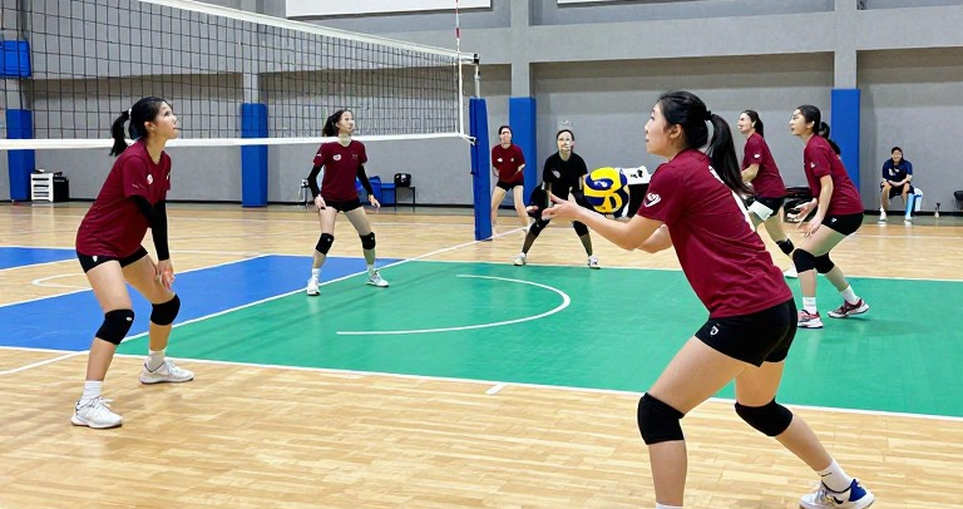
Assemble the pieces and the operating model becomes clear: one import opposite as the terminal anchor, one middle blocker as the second door, one libero carrying the back court, one young outside hitter in an accumulation phase.
In Vietnamese women's volleyball, the import slot is almost always spent on a terminal attacker. That is a rational points-optimisation choice. The price is equally clear.
Mihajlović is 35. At every elite club she has played for, the trade-off between her terminal value and her back-court coverage has been resolved the same way: reduce her serve-receive load, spend her on high balls in decisive phases. At 35, that is close to a default.
The consequence is that reception duty shifts onto Nguyễn Khánh Đang and the outside-hitter pair. That is exactly the configuration that collapses against heavy jump serving and a tall, disciplined block. An opponent only needs two good serving sets to turn Mihajlović's advantage into an isolated attacker on the right side.
I have no data proving this happened during 2026. I have structure, and the structure says the risk sits in reception, not in the attacking arm.
The second risk is rotation. When Mihajlović rotates to the back row, the front-court pair is Lê Thanh Thúy and Bùi Thị Ánh Thảo. Two good players, but not two terminal options at the level of a world-champion opposite. Any opponent with video analysis knows which window to load the block. The release supplies no rotation-level data, so this stays a flagged hazard, not a confirmed weakness.
The third risk is systemic: the availability of a 35-year-old import on a short contract. The Vietnamese domestic calendar is low-density with short travel, so physical load is not the binding constraint. The binding constraint is injury, visa, or any contract interruption. If the anchor goes, the team loses its first terminal option.
The phrase "flexible tactics" and the verification problem
The club's feature uses "flexible tactics" twice to describe how the team operates. The phrase arrives with no mechanism attached: no rotation design, no serve-targeting scheme, no tempo description, no setter distribution data by zone.
In Vietnamese volleyball communications, "flexible tactics" is a stock phrase. It appears when a writer wants to say the team plays well without specifying where. I have heard it at three different clubs in four recent seasons, and never once with a stat sheet attached.
One thing about how I work. In 2026 I mispronounced Luka Modrić's name three times in a single commentary half, despite having spelled it correctly in 47 analytical pieces beforehand. The nickname that followed haunted that tournament, and it taught me something I have never forgotten: theoretical knowledge does not save you when reality operates differently. Since then, every foreign name in my copy carries a phonetic note, and every tactical claim needs a foundation.
The claim of "flexible tactics" has no foundation. It is not wrong. It is simply unverified, and in my line of work unverified means parked — never used as the base for a further conclusion.
The same applies to the Hùng Vương Cup. It is a preparatory, invitational-style event. A title there is a form signal, not a strength signal. The club merges the two in its opening section. That is standard communications practice, and it is exactly what readers need to spot.
The contrarian read: crowds do not return for a semifinal ticket
The feature's headline speaks of a hunger to bring spectators back. That is a respectable aim, and I believe the club means it. But the common outside reading — that good results automatically pull crowds in — misreads how Vietnamese volleyball audiences actually work.
Domestic volleyball crowds do not come because a team is winning. They come because they know what they are about to watch. A legible match — clear roles, positional stories, one player you know will get the ball in the decisive phase — keeps people in their seats through the fourth set. An illegible match, even a 3-0 win, brings nobody back the following week.
Here is the gap I see. The club is telling a results story, while what generates an audience is an operating story. The release says nine wins from fourteen. It does not say who receives serve when Mihajlović rotates back, who is the primary blocker, what share of fifth-set balls the setter sends to the middle. Those are the things that make someone buy a second ticket.
One parallel, distant as it sounds. A injured player's return timeline is always controlled by the team's communications department, and "wait until the weekend" almost always means the injury has not healed. A crowd's return timeline works the same way. It is controlled by communications, and milestones like "the hunger to bring spectators back" tend to be announced before any substantive change in the on-court product.
I am not saying the club is inflating anything. I am saying a claim about spectators cannot be verified by another claim about spectators. It is verified by tickets sold, and tickets sold is the one dataset no self-produced feature ever publishes.
What worries me more than a defeat
The detail that stopped me longest in this whole story is not from 2026. It is from 2026.
That year, a generation of Hà Nội-trained players was transferred to Hóa chất Đức Giang, now Đức Giang Lào Cai. Among them were Trần Thị Bích Thủy and Lý Thị Luyến, both of whom became mainstays of the Vietnamese national team. The feature states plainly that these talents "continued to develop but no longer played for the Hà Nội women's team."
Reading that line without pausing means missing the pivot of an entire decade. The capital produced national-team-calibre players and then watched a provincial chemical company harvest them. That is a talent-supply-chain failure at the highest level, and it explains why the club has been promoted and relegated three times in three years.
So when I read that the current roster includes internationals, national-team players, and athletes raised in the capital's system, I read it as an attempt to reverse the 2026 pattern. Keep your own output, add an import, instead of producing and losing.
A name can be smeared, but its heartbeat cannot. This club has been smeared in the literal sense for three years: down, up, down, up. Its real heartbeat — the training system, the player pipeline, the organisational capacity — is still there. A five-year sponsorship signed while in the second tier is evidence that someone outside the building could read that heartbeat too.
A compressed season, and what to watch next
This is a major-event season, and Vietnamese women's volleyball sits mid-cycle toward Los Angeles 2028. The national team broke into Asia's top tier across 2026-24, with the 2026 FIVB Challenger Cup title and a first-ever VNL appearance in 2026. 2026 is a consolidation year, and every club with national-team players must plan for mid-season call-ups.
For Hà Nội Tasco Auto, that makes squad depth a practical question rather than an academic one. The feature names five players. A semifinal needs fourteen. The distance between those two numbers is the entire risk profile of this team for the rest of the season.
I will watch three things in the semifinal.
First, the reception configuration. If Mihajlović stands in the serve-receive formation for two rotations or more, the team is accepting a trade-off and I want to see how the opponent exploits it. If she is hidden entirely, the load falls on Khánh Đang and the outside pair, and I want to know how much jump serving they can absorb.
Second, the setter's distribution in the fourth and fifth sets. The 14 October point showed a setter willing to use the middle in the decisive phase. Once is a signal. Three times in one match is a system. I need more sample.
Third, whether the club publishes any technical metric at all. It is a small test with real meaning: a club talking about a hunger to bring spectators back while publishing no spike success rate is selling emotion, not product.
Closing
I spent 189 silent days during the pandemic re-watching 120 matches of an old team, and the biggest lesson from that stretch was not a tactical model. It was this: a team tells you more through what it does not publish than through what it does. Hà Nội Tasco Auto published nine wins, a cup title, a semifinal place, and a world-champion import. It did not publish five defeats, a 2-from-7 rate in the hardest segment, or a single technical metric.
Age 58 has taught me that the truest match sits off the court. This team's truest match will be the semifinal, when the anchor gets double-blocked, when the reception line gets targeted, and when there is no phase one left to bank points against. If they win there, the story changes completely, and I will be the first to rewrite my division.
I follow the team, but really I follow their heartbeats. Hà Nội Tasco Auto's heartbeat over three years has been the rhythm of promotion and relegation. This season, for the first time in a long while, that rhythm is moving sideways and slightly up. That is a reason to watch. It is not yet a reason to declare.